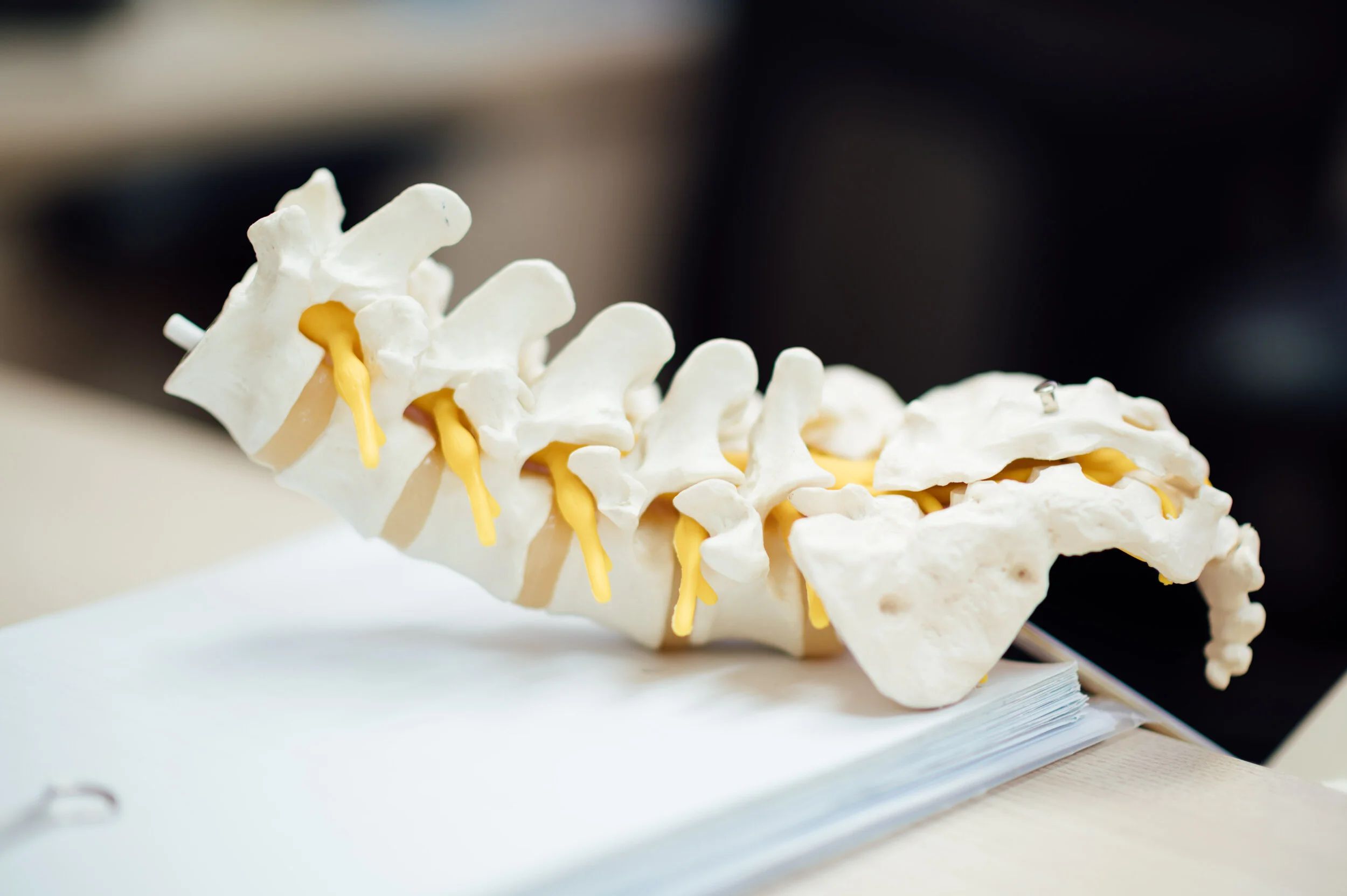

What is a slipped disc?
Between each bone (vertebrae) in your spine sits a disc — a cushion with a soft, jelly-like centre (the nucleus) held inside a tougher outer ring (the annulus). A slipped disc, also called a herniated or prolapsed disc, occurs when part of the soft centre jelly pushes through a tear in the outer ring. If the displaced material presses on a nearby spinal nerve, it can cause pain, numbness or weakness along the path of that nerve.
Despite the name, the disc doesn’t always slip out — it may protrude out or present as a bulge in the disc. Slipped discs are commonest in the lower back (lumbar spine) and in the neck (cervical spine).
Strictly speaking, a slipped disc refers to a herniation of the soft inner jelly (the nucleus) out through the annulus. However, the term “slipped disc” can also be used loosely to mean any disruption of the normal equilibrium between the nucleus and the tough fibrous outer ring. That disruption spans a range of disc states:
- an annular tear — a tear in the outer lining of the ring;
- a disc bulge — where the weakened annulus can no longer support the load, which the spine places on it, and starts to bulge outward;
- a minor disc protrusion;
- a herniation; and further to
- disc extrusion and sequestration.
These are all different states of the same disc.
What causes a slipped disc?
Discs lose water content and flexibility with age, which makes the outer ring more prone to tearing. A herniation can then be triggered by:
- Age-related disc wear (the most common factor)
- Lifting heavy objects with the back rather than the legs
- Sudden strain, twisting or a fall
- Repetitive bending or prolonged sitting, for example after long hours at a desk
- Being overweight, which loads the lower spine1
- Smoking, which reduces the disc’s blood and nutrient supply2
What are the symptoms of a slipped disc?
Symptoms depend on the level at which the disc has herniated and whether a nerve is compressed:
- Lower back (lumbar): pain radiating through the buttock and down the leg (sciatica), sometimes with numbness, tingling or weakness in the leg or foot.
- Neck (cervical): pain radiating into the shoulder and down the arm, sometimes with numbness or weakness in the arm or hand.
- Pain that is often worse when sitting, bending, coughing or sneezing.
- Some people have back or neck pain with no leg or arm symptoms at all.
Symptoms tend to flare when the loading pattern on the disc changes — in the neck with neck movements, and in the lower back with changes of posture such as bending forwards or backwards, sitting, coughing or sneezing.
Not every herniated disc causes symptoms — some are found incidentally on scans done for other reasons3.
How is a slipped disc diagnosed?
Diagnosis begins with a clinical assessment: your history and a physical examination that tests movement, reflexes, sensation and muscle strength to identify which nerve is affected.
A slipped disc in the neck may present with one-sided neck pain — to the left or the right. This pain may be related to neck movement, which may radiate to the trapezius, shoulder, arm, hand and fingers on the affected side. A slipped disc in the lower back may present with back pain that travels to the hip and buttock and down the thigh, calf, leg and foot, often aggravated by bending, coughing, sneezing, or moving from sitting to standing. On examination, the doctor may find that the pain relates to neck or back movement or to raising of the leg (a straight-leg raise), along with loss of sensation or weakness in the affected upper or lower limb.
Radiological imaging is used to confirm the diagnosis and plan treatment:
- MRI — the most useful scan for showing discs and nerves.
- X-ray — to assess the bones and alignment (it does not show the disc itself).
- CT — used in selected cases, or when MRI is not suitable.
How is a slipped disc treated in Singapore?
Most slipped discs are managed without surgery. Treatment is matched to the severity of your symptoms and how they progress.
Non-surgical treatment
- Activity modification and rest — staying gently active rather than on strict bed rest.
- Physiotherapy — guided exercises to relieve nerve pressure and strengthen the supporting muscles.
- Medication — simple pain relief and anti-inflammatory medicines.
- Targeted injections — an image-guided epidural or nerve-root injection can reduce inflammation around an irritated nerve.
- Intradiscal procedures — in selected cases, a probe placed into the disc (radiofrequency, electrical or laser) can reduce the pressure inside the disc by shrinking part of the nucleus, reducing the outward force on the annulus and the load transmitted when posture or loading changes.4
Surgery
Surgery is considered when severe leg or arm pain does not settle after a course of non-surgical treatment, or when there is significant or progressing limb weakness.5 The most common operation is a microdiscectomy — removal of the fragment of disc pressing on the nerve, often through a minimally invasive (keyhole) approach.
How safe is a microdiscectomy?
Microdiscectomy is one of the most commonly performed spine operations. As with any surgery it carries risks — the main ones are nerve injury, infection, bleeding, a tear of the membrane around the nerves (a dural tear), and the chance that the disc herniates again. Serious complications are uncommon,6 and the specific risks for your situation are discussed with you before surgery. The operation is done with smaller incisions, magnified visualisation using a microscope or camera, and intra-operative monitoring of the nerves to help protect them during surgery. A microdiscectomy is covered in more detail on its own page.
How long is recovery?
Recovery depends on whether you are treated with or without surgery.7,8
| Treatment | Typical recovery guide |
|---|---|
| Non-surgical care | Symptoms often ease over 6–12 weeks |
| Minimally invasive microdiscectomy | Walking the same day; light activities within a few weeks |
| Return to heavier activity | Gradual, over several weeks, on your surgeon’s advice |
These are general guides only — your recovery depends on your circumstances and the specific treatment given.
Slipped disc treatment cost and care in Singapore
In Singapore, both consultations and surgery for a slipped disc may be partly covered by MediSave and by Integrated Shield plans, subject to withdrawal limits and the terms of your plan.9 Costs differ between subsidised care in the public (restructured) hospitals and private care, and depend on the specific procedure, implants and length of stay. Before any procedure, you should receive an itemised cost estimate so you can plan with your insurer.
Choosing an approach
The right treatment depends on your symptoms, scans and how they have changed over time. In peer-reviewed research comparing minimally invasive and open approaches to lumbar decompression, functional outcomes at 6 and 24 months were found to be similar — so the decision is guided by your anatomy and your goals. These will be discussed with you before any procedure.
The red flags above follow national guidance on cauda equina syndrome.10
Frequently asked questions
Can a slipped disc heal on its own?
Symptoms often improve with rest, activity modification and pain relief as the inflammation settles and some disc material stabilises. But the disc does not truly heal: extruded material does not return, and the weakened annulus stays a weak point, so a treated disc carries a higher risk of recurrence than a normal one.
Do I need surgery for a slipped disc?
Usually not — most people recover without surgery. Surgery is generally considered when leg or arm pain is severe and has not settled after several weeks of non-surgical treatment, or when there is progressive muscle weakness or any bladder or bowel change, which needs urgent assessment.
How long does recovery from a slipped disc take?
Non-surgical recovery typically takes six to twelve weeks. After a minimally invasive microdiscectomy, many people walk the same day and return to light activity within a few weeks, with heavier activity resuming gradually. Recovery varies with the individual and the procedure.
Is slipped disc treatment covered by MediSave in Singapore?
MediSave and integrated Shield plans may cover part of the cost of spine surgery and hospitalisation in Singapore, subject to withdrawal limits and your specific plan. Out-of-pocket costs differ between subsidised (public) and private care. An itemised estimate can be provided before any procedure.
What does a slipped disc feel like?
A slipped disc often causes sharp or burning pain that travels from the lower back down a leg (sciatica), or from the neck down an arm, sometimes with numbness, pins-and-needles or weakness. Back or neck pain alone is also common. Symptoms often worsen with sitting, bending or coughing.
References
- Shiri R et al., Am J Epidemiol 2014;179(8):929–937
- Huang W et al., Eur Spine J 2016;25:168–176
- Brinjikji W et al., AJNR 2015;36(4):811–816
- Mechanism: Chen YC, Lee SH, Chen D, Spine 2003;28(7):661–665 (cadaveric). Effectiveness evidence mixed: NICE Interventional Procedures Guidance 2004; Cochrane review, Gibson & Waddell 2007; Freeman, Eur Spine J 2006
- North American Spine Society guideline: Kreiner DS et al., The Spine Journal 2014;14(1):180–191; NICE guideline NG59
- Shriver MF et al., Neurosurgical Focus 2015;39(4):E6; SPORT trial, Weinstein JN et al., JAMA 2006;296(20):2451–2459
- Chiu CC et al., Clinical Rehabilitation 2015;29(2):184–195
- Peul WC et al., New England Journal of Medicine 2007;356(22):2245–2256
- CPF Board; Ministry of Health, Singapore — official guidance on MediSave and MediShield Life
- Germon T et al. (British Association of Spine Surgeons), The Spine Journal 2015;15(3 Suppl):S2–S4; NICE guideline NG59; NICE Clinical Knowledge Summary, Sciatica; GIRFT National Suspected Cauda Equina Syndrome Pathway
Discuss your symptoms with Dr Tow
Mount Elizabeth Orchard · Mount Elizabeth Novena